Sparen Sie 5 % bei Ihrer ersten Bestellung. Klicken Sie hier

Ihr Warenkorb

Ihr Warenkorb ist derzeit leer.

Schauen Sie sich diese Sammlungen an.

US Army M-1943 Herringbone Cotton Camouflage Pants (Modified)

Regulärer Preis £71.00
Stückpreis
per 
Versand wird an der Kasse berechnet.

Free Shipping over £79 + 30-day Returns.

How to measure? Size Guide

Have questions? Contact us

Models

5' 7", 143lbs / 170cm, 65kg. Size W30.

5' 11", 160lbs / 178cm, 72kg. Size W31. Shown.

5' 10", 160lbs / 177cm, 75kg. Size W32.

5' 11", 176lbs / 180cm, 80kg. Size W34.

5' 10", 194lbs / 178cm, 88kg. Size W36.

5' 11", 209lbs / 182cm, 95kg. Size W38.

    • Inspired by early 1943 U.S. Army two-piece HBT camouflage trousers, Bronson's Modified Pattern version is developed on the framework of the M-1943 pants. Made from 10 oz all-cotton herringbone twill in classic Duck Hunter camouflage, the fabric is pre-washed to prevent shrinkage. A high-rise, loose silhouette allows unrestricted movement.

      Designed for armored units, practical side pockets are added, while the original thigh storage pockets are repositioned to the front for easier access. A trapezoid-shaped hip pocket, inspired by a kangaroo pocket construction, allows essentials to be retrieved easily when seated or prone. Round holes at the leg hems accommodate cord or wire and assist with hang-drying after washing.

      True to original combat garments, every adjustment serves a clear purpose —prioritizing storage efficiency, accessibility, and mobility. Built for field use yet equally suited for daily wear, these trousers deliver a rugged look with no unnecessary decoration or cosmetic detail.

    Inspired by early 1943 U.S. Army two-piece HBT camouflage trousers, Bronson's Modified Pattern version is developed on the framework of the M-1943 pants. Made from 10 oz all-cotton herringbone twill in classic Duck Hunter camouflage, the fabric is pre-washed to prevent shrinkage. A high-rise, loose silhouette allows unrestricted movement.

    Designed for armored units, practical side pockets are added, while the original thigh storage pockets are repositioned to the front for easier access. A trapezoid-shaped hip pocket, inspired by a kangaroo pocket construction, allows essentials to be retrieved easily when seated or prone. Round holes at the leg hems accommodate cord or wire and assist with hang-drying after washing.

    True to original combat garments, every adjustment serves a clear purpose —prioritizing storage efficiency, accessibility, and mobility. Built for field use yet equally suited for daily wear, these trousers deliver a rugged look with no unnecessary decoration or cosmetic detail.

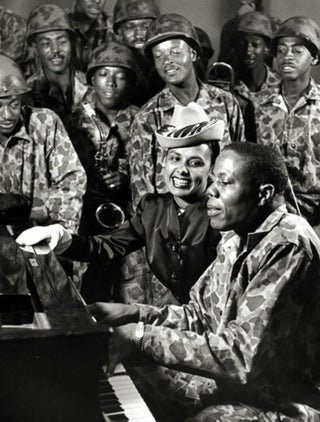
    At the beginning of World War II, the U.S. Army had no dedicated camouflage uniforms. In response to combat demands, the Army Engineering Department began developing camouflage clothing in 1940. The pattern was designed by California horticulturist Norvell Gillespie, featuring a reversible system: a five-color green scheme for jungle terrain and a three-color tan scheme for arid environments. The design was printed on durable Herringbone Twill (HBT), a fabric already widely adopted by the military.

    In August 1942, the reversible one-piece jungle suit was approved as standard issue. Its mottled appearance earned the nickname "Frog Skin", while the term "Duck Hunter Camo" later emerged from its widespread post-war use in civilian hunting garments. Although camouflage uniforms saw limited frontline use during WWII, the pattern went on to influence outdoor wear and modern military-inspired design for decades.

    Reviews